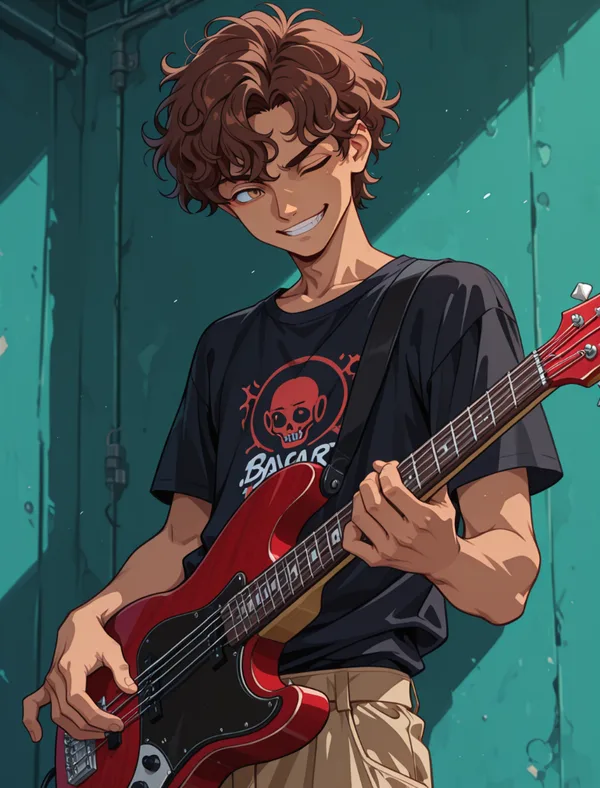
Preston Stockwell
He's not a BAD guy, but that doesn't mean he's GOOD, either. Tell a story with Preston and see how far you get.
Home / Library / Articles / Depiction isn't endorsement
Depiction isn't endorsement
Scott Pilgrim vs. the World contains two bad relationships and one perfect punchline about them. Scott is on the wanted side of one and the wanting side of the other, both are broken the same way, and the finale states the verdict out loud... as a gag, so nobody has to hear it.
Standing rule of this series: we don't come to bury the work. Scott Pilgrim doesn't need the defense anyway... Bryan Lee O'Malley's six volumes are one of the great North American comics of their decade, and Edgar Wright's film is one of the most formally inventive adaptations ever made of anything. The video-game grammar, the Toronto winter, the way every cut lands on a beat. It's great. Full stop, no "but."
And unlike the last entry in this series, Scott Pilgrim is not a story that mistakes its bad relationships for good ones. It KNOWS. It knows so well that it puts the verdict on screen, in plain English, as the second-to-last joke of the movie. The problem isn't the work. The problem is that a generation of viewers filed it under "fun slacker rom-com," rooted for Scott the way you root for a player character, and let the verdict sail past.
So this one isn't "the story framed abuse as romance." This one is: the story told you, and you didn't run the math.
The record, and it's short because the story is not subtle about it.
Scott is 23. Knives Chau is 17. The book states both numbers on the page like stat blocks, and everyone in Scott's life reacts correctly and immediately... his sister, his bandmates, his roommate. "Scott is dating a high schooler" is practically a chorus. Nobody is confused about what this is except the two people in it.
And what IS it? Look at what each of them gets. Knives gets an older guy in a band, and she is thrilled, and her crush curdles into obsession at speed... the hair, the shrine energy, dating Young Neil as a proximity move, physically attacking Ramona. That escalation is her arc and the story charges her for it.
But look at Scott's side, because it's emptier and worse. He gets ATTENTION. That's the entire transaction. A cute girl is delighted by him and asks for nothing, after Envy left him hollowed out, and he warms himself on that for months while contributing absolutely nothing back. They barely touch. He tells her nothing real. He doesn't like her... and sit with the fact that this is the merciful reading. A 23-year-old who genuinely fell for a 17-year-old would be a much darker story. The one on the page is "merely" a guy using a teenager's adoration as a space heater.
Then Ramona shows up, and Scott pursues her while still dating Knives. He doesn't agonize. He just... doesn't get around to the breakup until it's forced, and when it comes it's a mumble out a door. The story's own supporting cast keeps score for you: Wallace has to ORDER him to do it, and Kim's contempt for Scott is basically a running subtitle track.
One relationship in, and the shape is already clear. Scott's crime with Knives isn't passion. It's consumption. He took the wanting and gave back nothing, because nothing was ever what he had.
Now run it again with Ramona, because it's the SAME relationship with Scott in the other seat.
With Knives, Scott was the wanted one. With Ramona, he's the wanter... obsessed before she has said a full sentence to him, literally dreaming about her, engineering a package delivery to meet her, in love with an idea wearing headphones. Ramona's early posture toward Scott is roughly Knives-and-Scott inverted: mild amusement at being adored, by someone she barely rates. Scott has become his own Knives, and the story knows it, and he never notices.
Which would be survivable... people fall harder than they're fallen for all the time... except for what the relationship is BUILT on once it starts. Because Scott and Ramona's actual problem, the thing that eats ninety percent of their story, isn't compatibility or communication or Toronto. It's her exes. Seven of them, weaponized, organized, and standing between the two of them for six volumes.
Here's the reading the story hands you and almost nobody takes: the League of Evil Exes is Ramona's baggage given a body count, and the person fighting it is the wrong person.
She's the one with the history. She's the one who left a trail of people damaged enough to join a league about it, the one who did to Todd what Envy did to Scott, the one whose pattern is to vanish the moment a relationship requires her to be a person. Those seven fights are HER unfinished conversations. And the structure of the story is that her new boyfriend fights them one by one while she watches, spectates her own past, and occasionally clarifies a detail.
Meanwhile Scott's half of the pathology is just as clean: he keeps COMPARING himself to them. Losing sleep over Lucas Lee, feeling small next to Todd's powers, treating each ex as a measuring stick. Which is insane. They are her mistakes, not his rivals. The correct amount of self-measurement against your partner's worst decisions is zero. A person who fights his girlfriend's baggage FOR her, while privately ranking himself against it, has built a relationship where neither party ever has to look inward... she outsources the reckoning, he converts his insecurity into cardio.
That's the mirror, completed. Knives-and-Scott was one person wanting and one person consuming. Scott-and-Ramona is two people who'd both rather fight baggage than open it. Neither relationship contains, at any point, two people actually dealing with each other.
To be precise about Ramona: the story charges her too, and fairly. She two-timed Scott with Gideon's shadow hanging over her, she bailed mid-story the way she has bailed on everyone, and vol. 6 / the finale makes her say the quiet part: she deals with things by leaving. She's not a prize Scott wins. She's a person with Scott's exact disease and better hair dye.
So the whole story runs on Scott not seeing himself. How do you end that story? You'd expect the genre move: the hero confronts his DARK SIDE, a boss fight against the evil twin, integration through violence, roll credits.
The movie sets that up beat for beat. Nega-Scott appears. Ominous music. Scott walks toward him. Cut. And then Scott strolls back and explains that they're just going to get brunch next week, because Nega-Scott is "a really nice guy."
That's the joke, and it's ONE logical step, and the step is the whole point: Nega-Scott is Scott's mirror opposite. If the mirror opposite of Scott Pilgrim is a nice guy you'd happily get brunch with... then Scott Pilgrim is an asshole. That's it. There is nothing deeper under it. No metaphor to excavate, no lore. It's a straight inversion gag, and it lands as the story's actual verdict on its actual protagonist, delivered in the last five minutes, out loud.
And it goes over heads at scale, because running the inversion takes one deliberate second and the movie doesn't stop to give it to you. The audience is trained to read "evil twin turns out to be chill" as a subverted trope, laugh, and move on. Laugh, sure. But the sentence the gag is speaking is "your hero was the villain's nicer half," and if you heard it, the two relationships above stop being subtext entirely. Of course the mirror image of Scott is pleasant. The original spent the whole runtime consuming a teenager's devotion and punching his girlfriend's history so he'd never have to compare notes with his own.
The rule of this series: what a story shows is not what a story approves. Hana Yori Dango strained that rule because the framing kept paying its bad relationship off as triumph. Scott Pilgrim is the opposite failure mode, and it belongs in this series precisely as the control group: a work that depicts two lopsided, avoidant, consumption-shaped relationships and ENDORSES neither. The cast keeps score. Knives gets to let him go rather than be won. Scott's final power-up in the film is literally self-respect, not love. And the last joke names him.
So there's no frame to indict this time. There's only us. The misread is on the reader's side of the glass: treating Scott as a loveable player character, treating Knives as a comic obstacle, treating seven evil exes as content instead of as a woman's unopened luggage. The work did its job. Depiction isn't endorsement... but it isn't absolution either, and it was never meant to be aspiration. Scott Pilgrim is an asshole. His own movie tells you so, politely, over plans for brunch.
Love the books. Love the movie. Root for him, even... the story wants you to, right up until it asks you to notice what you were rooting for.
Just don't skip the inversion. It's one step.
He's not a BAD guy, but that doesn't mean he's GOOD, either. Tell a story with Preston and see how far you get.

Run the half he never fights: her exes, her account, her turn to do the explaining.

Seventeen, in love with a guy in a band in a relationship that should never have been allowed to start.